.png)


China's Parliament has overwhelmingly casted a ballot to affirm another law forcing national security enactment on Hong Kong to handle what Beijing has marked severance, disruption, psychological warfare and remote impedance in the semi-self-ruling city.
The National People's Congress casted a ballot 2,878 to 1 for the choice to engage its standing panel to draft the enactment, with six abstentions.
The officials accumulated in the Great Hall of the People burst into continued acclaim when the vote count was anticipated onto screens.
The new law will modify previous British state's smaller than expected constitution, or Basic Law, to require its Government to authorize measures to be chosen later by Chinese pioneers.
It is relied upon to be sanctioned before September.
In light of the enactment's entry, the United Kingdom, the United States, Australia and Canada chastened China, as they said it would compromise opportunity and break the report that sets out Hong Kong's halfway independence, the 1984 Sino-British Joint Declaration.
"China's choice to force the new national security law on Hong Kong lies in direct clash with its universal commitments under the standards of the lawfully official, UN-enrolled Sino-British Joint Declaration," they said.
"We are additionally incredibly worried that this activity will worsen the current profound divisions in Hong Kong society."
The new national security enactment would likewise "shorten the Hong Kong individuals' freedoms, and in doing as such, drastically dissolve Hong Kong's self-governance and the framework that made it so prosperous."
Be that as it may, Hong Kong Chief Executive Carrie Lam tended to disagree in an announcement discharged before today.
Ms Lam said her Government would completely help out China to "complete the important administrative work as right on time as could be expected under the circumstances".
Hong Kong's incomplete independence from China is spread out in two reports: The Sino-British joint statement and the Basic Law.
Both specify China's standard over Hong Kong accompanies huge admonitions, including the continuation of British free enterprise, custom-based law, common freedoms, just as the understanding that Beijing would not have the option to straightforwardly mediate in the city for a time of 50 years from the city's 1997 handover.
Activists have cautioned the security laws could stop the independence revered in these two reports, and Beijing's semi-self-governing decision structure known as "one nation, two frameworks".
They have griped the law will sabotage common freedoms and may be utilized to smother political action.
In any case, Chinese specialists and the Beijing-supported Government in Hong Kong state there is no danger to the city's independence and the new law will be firmly engaged.
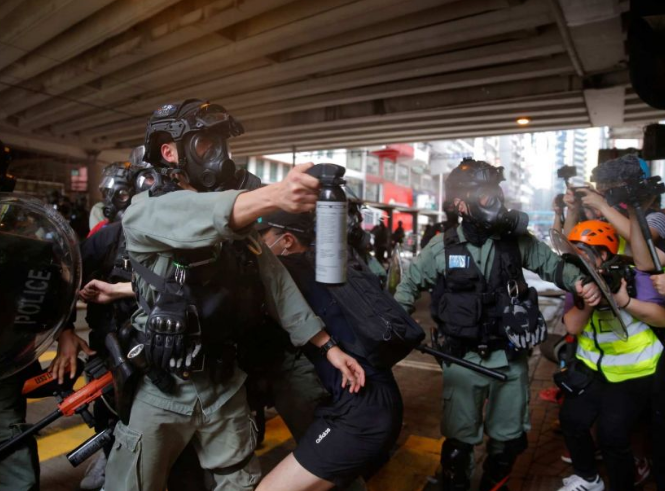
China disclosed the enactment a week ago, setting off the primary large fights in Hong Kong for a considerable length of time.
Jeremy Tam, an individual from Hong Kong's Legislative Council, said there was no open interview and the voice of domain's residents was totally disregarded during the administrative procedure.
"[It] in a general sense damaged human rights vowed to Hong Kongers under the Basic Law and was lamentable to the "one nation, two framework" rule," Mr Tam said.
"The enactment made an Orwellian 'thought wrongdoing' by condemning acts which 'compromise national security, and incorporates secessionist and incendiary movement, for example, outside obstruction and fear based oppression'.
"The 'violations' have unclear definitions and might incorporate any endeavors to voice out contradiction against the Government."

The security law could see Chinese insight offices set up bases in the city.
The measure and the manner in which it is being authorized provoked the United States to declare it would no longer treat Hong Kong as being self-sufficient from the Chinese territory.
Recently, US Secretary of State Mike Pompeo said Hong Kong would no longer fit the bill for uncommon treatment under US law, conceivably managing a devastating hit to its status as a significant money related center.
The security law was "just the most recent in a progression of activities" sabotaging Hong Kong opportunities, he told Congress.
"No sensible individual can attest today that Hong Kong keeps up a high level of self-sufficiency from China, given realities on the ground," he said
Relations between the two superpowers have been tense over China's cases in the South China Sea and exchange.
The coronavirus pandemic has likewise become an issue of rancor.
Hong Kong's commencement to 2047
Hong Kong was given back to China with no structure for what might occur after the year 2047, leaving the city to cut a personality out of two ideologically restricted domains.
Understand more
Japan likewise said it was "truly worried" about the transition to go ahead with national security enactment.
In an uncommon explanation gave minutes after the security bill was endorsed, Japan called Hong Kong a "critical accomplice", underscoring close monetary ties and individuals to-individuals trades.
"Japan is truly worried about the [Chinese parliament's] choice," the Foreign Ministry explanation said.
"It is the long-standing strategy of Japan to join incredible significance to maintaining a free and open framework which Hong Kong has been getting a charge out of and the vote based and stable improvement of Hong Kong under the 'one nation, two framework' structure."
Tokyo's remarks come as Taiwan has vowed to settle Hong Kongers who escape the Chinese-governed city for political reasons, offering assistance from work to advising.
Taiwan's President Tsai Ing-wen this week turned into the principal world pioneer to promise explicit measures to help individuals from Hong Kong who may leave the previous British province in light of the new enactment.
Chen Ming-tong, leader of Taiwan's top China-arrangement creator, the Mainland Affairs Council, told parliament the Government will set up an association to convey "helpful alleviation" that remembers settlement and work for a joint exertion with activists gatherings.
He said advising administrations will likewise be accessible for Hong Kongers, some of whom may partake in progressively vicious genius majority rule government dissents in Hong Kong.
"Numerous Hong Kongers need to come to Taiwan. We will likely give them settlement and care," Mr Chen said.
Chen didn't give subtleties, for example, scale and timing of the help when squeezed by legislators, saying the Government is as yet chipping away at the program.
China claims sway over Taiwan as a rebel breakaway region, anyway 15 nations around the globe including the Holy See perceive Taiwanese power.
In light of Taipei's mediation, China's Taiwan Affairs office asserted "bringing dark, savage powers into Taiwan will carry calamity to Taiwan's kin".

28/05/2020 05:09 pm

-450px.png)
-450px.png)

-450px.png)

