.png)


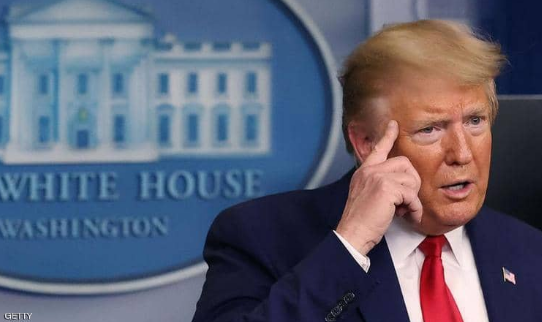
WASHINGTON - President Donald Trump said Friday that the U.S. will end its relationship with the World Health Organization, saying it had neglected to sufficiently react to the coronavirus in light of the fact that China has "all out control" over the worldwide association.
He said Chinese authorities "overlooked" their revealing commitments to the WHO and constrained the WHO to deceive the world when the infection was first found.
He noticed that the U.S. contributes about $450 million to the world body while China gives about $40 million.
The U.S. is the biggest wellspring of money related help to the WHO and its exit is relied upon to essentially debilitate the association. Trump said the U.S. would be "diverting" the cash to "other worldwide and meriting earnest worldwide general wellbeing needs," without giving points of interest.
"THIS IS A BREAKING NEWS UPDATE. AP's previous story follows underneath."
The Trump organization may before long oust a great many Chinese alumni understudies selected at U.S. colleges and force different authorizations against Chinese authorities in the most recent indications of strains among Washington and Beijing that are seething over exchange, the coronavirus pandemic, human rights and the status of Hong Kong.
President Donald Trump said he would make a declaration about China on Friday, and organization authorities said he is thinking about a months-old proposition to renounce the visas of understudies partnered with instructive establishments in China connected to the People's Liberation Army or Chinese insight.
Trump is additionally weighing focused on movement and budgetary authorizations against Chinese authorities for activities in Hong Kong, as indicated by the authorities, who were not approved to talk about the issue openly and talked on state of secrecy.
"We'll be declaring what we're doing tomorrow regarding China and we are not content with China," Trump told columnists at an inconsequential occasion Thursday, alluding basically to COVID-19. "We are not content with what's occurred. Everywhere throughout the world individuals are enduring, 186 nations. Everywhere throughout the world they're languishing. We're unsettled."
In spite of the fact that the understudy removals aren't legitimately identified with Hong Kong and China's transition to attest full command over the previous British domain, potential assents against authorities associated with that exertion would be an aftereffect of Secretary of State Mike Pompeo's assurance that Hong Kong can never again be viewed as independent from terrain China.
Pompeo informed Congress on Wednesday that Hong Kong is done meriting the special exchange and business status it has delighted in from the U.S. since it returned to Chinese standard in 1997. Under a joint Sino-British concurrence on the handover, Hong Kong was to be represented uniquely in contrast to the territory for a long time under a "one nation, two frameworks" arrangement.
Pompeo's assurance made the way for potential approvals and the loss of uncommon advantages Hong Kong has gotten from the United States. Yet, neither Pompeo nor different authorities had the option Wednesday to portray what move the organization may make, a vulnerability identified with the effect that such endorses would have on U.S. organizations that work in Hong Kong and the city's situation as Asia's major money related center point. Trump's remarks started a drop in U.S. monetary markets.
Genuine thought of the visa renouncement proposition, first revealed by The New York Times, has confronted restriction from U.S. colleges and logical associations who rely upon education costs paid by Chinese understudies to counterbalance different expenses. Likewise, those establishments dread conceivable proportional activity from Beijing that could constrain their understudies' and instructors' entrance to China.
In a gesture to those worries, the authorities said any limitations would be barely customized to influence just understudies who present a critical danger of taking part in undercover work or protected innovation burglary. The authorities couldn't state what number of individuals could at last be removed, in spite of the fact that they said it would be just a small amount of the Chinese understudies in the nation.
In any case, the likelihood that the proposition might be actualized has drawn worries from teachers.
"We're stressed over how extensively this will be applied, and we're concerned it could communicate something specific that we not, at this point invite skilled understudies and researchers from around the world," said Sarah Spreitzer, executive of government relations at the American Council on Education.
"We don't have a ton of insights concerning how they will characterize connections to Chinese colleges, what kind of colleges are they going to target, what might comprise a college having connections to the Chinese military," she said. On the off chance that the circumstance were turned around and another country forced cutoff points on understudies from U.S. colleges that get Defense Department financing, she noted it would influence a wide scope of schools.
The U.S. facilitated 133,396 alumni understudies from China in the 2018-19 scholastic year, and they made up 36.1% of all global alumni understudies, as indicated by the Institute of International Education. Generally speaking, there were 369,548 understudies from China, representing 33.7% of global understudies who contributed almost $15 billion to the U.S. economy in 2018.
The proposition to disavow the visas isn't legitimately identified with the disagreement about Hong Kong, nor is it attached to U.S. analysis of China for its treatment of the coronavirus flare-up. Or maybe, it is associated with different components of exchange and human rights gives that have seen U.S. authorities whine about Chinese mechanical undercover work and spying and provocation of protesters and strict and ethnic minorities.
However, the planning of a potential declaration could come during a period of progressively warmed talk about the burden of national security laws on Hong disregarding the Sino-British accord.
The proposition initially started to be talked about a year ago when the organization moved to require Chinese ambassadors situated in the United States to report their household U.S. travel and gatherings with American researchers and scholastics. At that point, U.S. authorities said it was a corresponding measure to coordinate limitations that American negotiators face in China.
Those cutoff points were trailed by a prerequisite that Chinese state-run media in the U.S. register as "outside strategic missions" and report their property possessions and worker programs to the legislature. That was, thusly, trailed by the constraining of the quantity of visas for Chinese columnists permitted to work in the United States.
China fought back for the visa constraints by ousting a few journalists from U.S. news sources, including The Washington Post and The New York Times.

30/05/2020 03:15 am

-450px.png)
-450px.png)

-450px.png)

