.png)


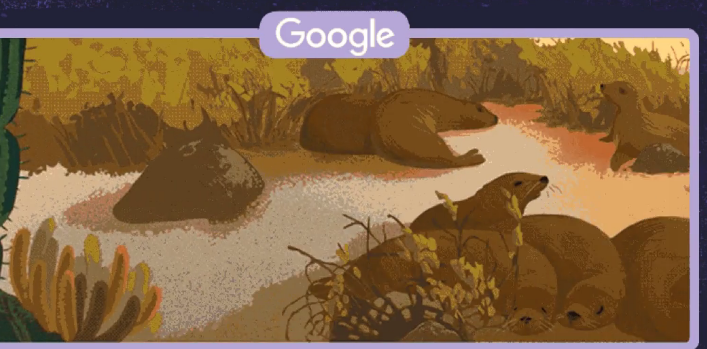
The Galapagos Islands, an archipelago in excess of 500 miles off Ecuador in the Pacific Ocean, were put on the map by Charles Darwin's hypothesis of regular choice, which was framed from perceptions the British naturalist made to the islands during his well known journey of the HMS Beagle in 1830s.
The 19 for the most part uninhabited islands' exceptional topography and segregation are home to many extraordinary greenery discovered no place else on the planet, including the goliath Galapagos tortoise, the biggest living tortoise. It's likewise the main creature delineated in Sunday's Google's slideshow Doodle praising the commemoration of the islands being announced an UNESCO World Heritage Site in 1978.
UNESCO, short for United Nations Educational, Scientific and Cultural Organization, applies the World Heritage Site assignment to tourist spots or zones that have social, authentic, logical or another type of importance, giving them legitimate assurances under universal arrangements. Other UNESCO destinations honored by Google Doodles incorporate Ireland's sensational Cliffs of Moher and Skellig Michael, a magical island off the shore of Ireland put on the map to a large number of film fans through the latest Star Wars motion pictures.

Darwin put his on the map visit to the Galapagos Islands in 1835 during a round-the-world journey. Basically intrigued by topography at that point, Darwin alluded to the archipelago as "that place where there is pits" and through his perceptions, clarified how volcanic tuff is framed. In any case, he additionally saw that mockingbirds varied from island to island, a perception that prompted his hypothesis of development as point by point in his 1859 book On the Origin of Species.
Notwithstanding the Galapagos tortoise, the slideshow highlights the blue-footed booby, iguanas, the hide seal and the main penguin known to live north of the equator.

31/05/2020 12:47 pm

-450px.png)
-450px.png)

-450px.png)

