.png)


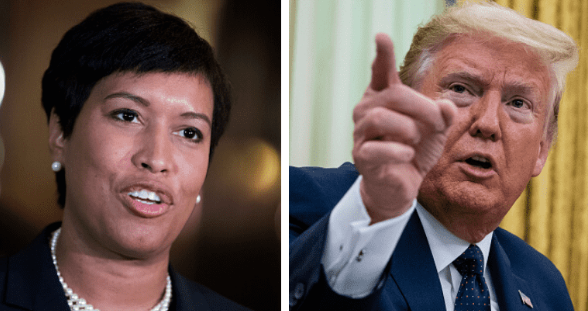
The countrywide fights over the disastrous demise of George Floyd in Minneapolis a month ago has seen a remarkable bend with Washington DC Mayor Muriel Bowser starting discussion over summoning the Constitution's Third Amendment to kick military soldiers out of the capital. Gigantic soldiers were prepared to manage the nonconformists in the national capital after President Donald Trump took steps to utilize military power against them. Be that as it may, his arrangement was met with kickback both from the nation's regular citizen and military pioneers.
At a question and answer session on Thursday, June 4, Bowser stated: "The absolute first thing is we need the military - we need troops from out-of-state out of Washington, DC", starting the protected discussion. The 47-year-old city hall leader, additionally an African-American, has been at loggerheads with the government specialists drove by Trump over controlling Washington's roads since the time an email from a military organizer cautioned her office. On Wednesday, June 3, the military authority looked for direction for the US Northern Command in deciding "course limitations" for the "development of strategic vehicles" and "military powers" from Fort Belvoir, Virginia, into the capital city to aid the "Common Disobedience Operations", as per a Washington Post report. For Bowser's office, this implied a quick acceleration in the government troops Trump tried to subdue the road dissents close to the White House. It was only days back that the president blamed Bowser on Twitter for declining to permit DC police to contribute to controlling the group in Lafayette Square.
Indeed, even as the military authority chose to turn around the arrangement to evacuate the soldiers out of the city, in excess of 4,500 National Guard individuals remained conveyed to DC on Thursday, June 4. A few states, including Florida, Indiana, Maryland, Ohio, Mississippi, Missouri, New Jersey, South Carolina, Tennessee and Utah, sent their Guard troops after Defense Secretary Mark Esper mentioned.
While the Guard remained the main military power to work in the national capital, Bowser doesn't have the authority over the DC National Guard which works under the order of the military secretary, CNN announced. Maryland Governor Larry Hogan said on Wednesday, June 3, that Maryland National Guard troops that he sent to DC were doled out with the errand of guarding the national landmarks however Bowser said she had no such words with Hogan and henceforth couldn't support of the mission.
Bowser's choice to expel troops has confronted analysis from Republicans like Utah Senator Mike Lee, who tweeted on June 4: "Recently heard that Mayor Bowser is kicking the Utah National Guard out of all DC lodgings tomorrow. In excess of 1200 soldiers from 10 states are being ousted. This is unsatisfactory."
The Third Amendment, which is among the least discussed sections of the American Constitution, has abruptly become animated after Bowser's notice. What precisely is the alteration?
The Third Amendment (1791) to the US Constitution - a piece of the Bill of Rights - bars automatic quartering of troops in private homes. In spite of the fact that the arrangement has never gone under direct examination of the Supreme Court, its center standards were among the most notable ones at the hour of the nation's establishment. It was applicable before the American Revolution (1775-83) when the British, under the initiative of King George III, sponsored standing militaries in provinces with officers remaining in private habitations. This military nearness in the regular citizen space helped America's resistance to the British colonizers and saw Thomas Jefferson hammering King George III in the Declaration of Independence. At the point when the Constitution was sanctioned, the alteration got wide help to stop the act of keeping troops at private homes at the hour of harmony.
Not at all like the Second Amendment which has kept on observing wide discussion after some time, the Third Amendment stayed a calm bit of the tradition that must be adhered to. The full content of the Third Amendment peruses: "No Soldier will, in time of harmony be quartered in any house, without the assent of the Owner, nor in time of war, yet in a way to be endorsed by law."
The online life however was separated over conjuring the Third Amendment. While some said it isn't the city hall leader yet the proprietors of the lodgings who have the power to settle on pleasing soldiers, others discussed whether the inns where the soldiers have been quartered can be qualified as homes. There were likewise individuals who upheld Bowser for accepting a solid call to expel the positioned troops from the capital.

05/06/2020 08:17 pm

-450px.png)
-450px.png)

-450px.png)

