.png)


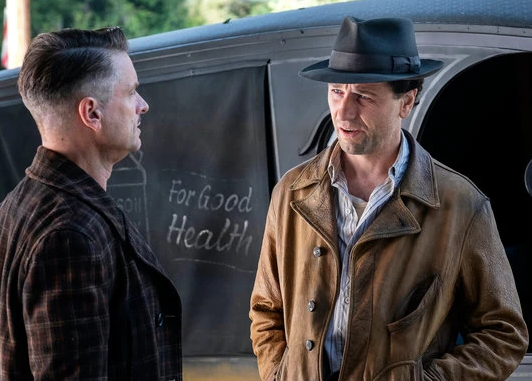
Matthew Rys plays the title character as a hard-karma private criminologist in this dull new prequel HBO arrangement. Your dad's Perry Mason he isn't.
The hero of in excess of 80 books by Erle Stanley Gardner, the star of radio plays and TV motion pictures and a long-running arrangement featuring Raymond Burr, the subject of a quite decent Ozzy Osbourne melody: Perry Mason has seen numerous manifestations since his 1933 creation.
Be that as it may, the renown TV adaptation of the character for HBO, played by Matthew Rhys and brought to you by the co-makers and co-essayists Rolin Jones and Ron Fitzgerald, isn't your dad's Perry Mason. Or on the other hand your granddad's or incredible grandfather's, so far as that is concerned. As found in the debut scene of the new "Perry Mason," he's not so much as a criminal protection legal counselor yet. He's nearer to the "criminal" finish of that descriptor than the "legal counselor" one, truth be told.
As played by Rhys, the skilled co-star of FX's bleak, incredible covert operative spine chiller "The Americans," Perry is the thing that you may call a hard-karma case. A veteran of World War I (World War II lies eight years later) who lives on his family's frail dairy ranch, he has a 9-year-old child he doesn't see and an ex who can't stand him. He squeezes out a living as a private agent, following a Fatty Arbuckle-type on-screen character for a film studio wanting to get him in an ethics condition infringement — at that point arrival himself in boiling water when he attempts to charge the studio more cash subsequent to getting a best in class diva in the go about too.
Artisan's inward circle incorporates his happy accomplice, Pete Strickland (Shea Whigham); E.B. Jonathan (John Lithgow), a lawyer who attaches him with occupations; Della Street (Juliet Rylance), Jonathan's legitimate secretary; and Lupe (Veronica Falcón), a pilot with whom he has incredibly excited sex … when she isn't caught up with attempting to purchase his homestead so as to account for the airstrip from which she works.
It's through E.B. that Perry handles the case that launches the scene, in abhorrent design. In a grouping coordinated with evil verve by the HBO backbone Tim Van Patten ("The Sopranos," "Promenade Empire," "Round of Thrones," and so on), the guardians of child Charlie Dodson race to safeguard their child from criminals who've put him on the Angels Flight railroad, promising to free him in return for an over the top payoff. At the point when his mother and father recover him, they find, sadly, that he is as of now dead, and that his eyes have been sewn open. (No doubt, we're far from Raymond Burr.)
Perry and friends go to the case by method of the rich timber financier Herman Baggerly (Robert Patrick), an individual from the guardians' congregation, drove by a magnetic figure called Sister Alice. As he explores, Mason crosses paths with the Los Angeles Police Department criminologists relegated to the case.
"I don't confide in the Los Angeles Police Department to carry out the responsibility that is required," Baggerly says. In the present atmosphere, that line sneaks up all of a sudden — even before we see one of those criminologists execute the plot of ruffians, with whom it's unmistakable he was in cahoots, without a second thought.
Debasement, torment, murder, full-frontal nakedness, profane demeanors, a dead infant: "Perry Mason" brags the full supplement HBO's type revisionist procedures. In any case, Rhys is the paste holding everything together. I can't remember the last time I saw a lead execution this epitomized, for absence of a superior word; all Rhys' looks, articulation and signal appears to be made of exhaustion the manner in which Abraham Lincoln's lodge was made out of logs. Credit should likewise go to the ensemble office, drove by Emma Potter, who dress him only in garments that look as though they were pulled out of the hamper into which they were hurled three days sooner. At the point when we find that Mason pay-offs the undertaker so as to take garments worn by individuals who have kicked the bucket in them, Yeah, that sounds about right is the main suitable reaction.
What's more, Rhys' exhibition as Perry isn't simply unfilled, poor me pitiful sackery. Maybe it's his insinuated encounters in the Great War seeping through, however he seems to be a man who is how he is on the grounds that the terribleness of the world outrageously gets to him. ("Most exceedingly awful thing you've at any point seen," the undertaker enlightens him concerning the dead infant. "What do you comprehend what I've seen?" comes the answer.) When Perry analyzes the child's disfigured cadaver, carefully removing a string used to line the newborn child's eyes open, the camera waits all over as he holds back frightfulness and distress. A slight tremor of the lower lip is the main physical purge his body permits him.
It's that shot, more than all else, that sold me on this adaptation of the character and his excursion through Los Angeles' 1930s underbelly. Any show that executes a youngster owes it to its crowd to pay attention to that slaughtering; this seems like an axiom, however such killings can give modest feeling and stun an incentive in deceitful hands. In spite of its Hollywood excitement and Perry's Murphy's Law jokes, "Perry Mason" is, from the start become flushed, a show that comprehends the gravity of what it has decided to present to the two its hero and its crowd.
It's likewise a show that furnishes the watcher with some unalloyed joys. I, for one, am a sucker for the lilt of Lithgow's voice, and I'll watch Whigham act in pretty much anything. Van Patten coordinates the scene with verve, shunning the more grave tones of normal glory toll.
Thus, the energetic score by Terence Blanchard remains in obvious help against both the musical methodology and the burbly synths that have become the business standard. "Perry Mason" doesn't generally look or sound or feel like whatever else on TV at this moment. That is a case I'm willing to take.
From the case records:
"Everyone's planning some mischief. Everyone has an edge, concealing something. Furthermore, everyone is liable." This smashed tirade by Perry, conveyed to his adoration intrigue Lupe, sure seems like a statement of purpose for the show to me.
Gayle Rankin accomplishes phenomenal work as Emily Dodson, the killed infant's mom. Her scene with Mason, wherein she IDs him as a veteran from the manner in which he holds his cigarette — intuitively protecting the coal with his hand to abstain from being found in obscurity — and regretfully comments on his child's age, is fittingly difficult to watch.
At the point when the initial title shows up over a road scene, Perry strolls directly through the letters, as though the show can hardly wait to get in progress. It's an unobtrusive stunt, yet it includes a need to keep moving.

22/06/2020 01:24 pm

-450px.png)
-450px.png)

-450px.png)

