.png)


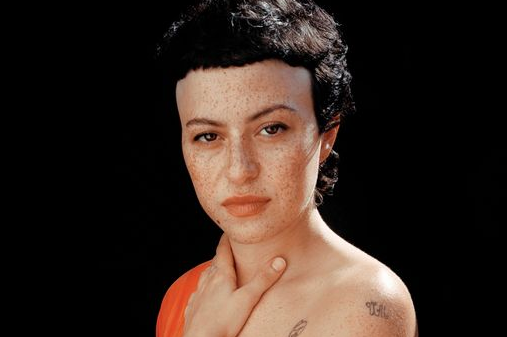
One morning the previous fall, joyfully stoned and painting alone in her specialty studio, Alia Shawkat understood her name was drifting on Twitter. Photographs of the entertainer leaving a Los Angeles playhouse nearby Brad Pitt had quite recently been distributed, and both the baser and apparently nobler sections of the web were agog. "I resembled, I don't accept this," says Shawkat in late May from her radiant Los Angeles kitchen, where she's simply woken up a little before 11:30 a.m., yanked on a brilliant blue pullover, and FaceTimed me, looking glowy and somewhat sluggish. As she describes the story, she switches back and forth between smoking a cigarette and tasting a green smoothie, every so often motioning with a larger than average blue lighter. "Every one of my companions resembled 'What's happening?' and sending me photographs," she says. "I just felt overpowered. It's that feeling of being exposed in school, similar to, Oh my God, everybody's taking a gander at me."
The hazy paparazzi snaps started decisively after Shawkat, 31, and Pitt, 56, were spotted at that playhouse, at Mike Birbiglia's small time appear, at a Thundercat show, at In-N-Out burger, at one of Shawkat's exhibition appears, and at Kanye West's drama. The photographs would be totally commonplace — the two giggle and embrace in coordinating fedoras and overcoats or discreetly contemplate an inexpensive food menu — notwithstanding the way that Pitt's dating life has for quite some time been analyzed with the enthusiasm of one billion unhinged researchers.
To move it: "We're not dating. We're simply companions," says Shawkat. (I trust her, if simply because she is so legit about how horny she's been during lockdown.) "I've gotten press, dislike that," she includes, her level, scratchy baritone belying her aggravation. "Not all that wild."
By early June, however, when Shawkat started inclining on Twitter once more, that paltry kind of press appeared to be a best reality to her. In 2016, Shawkat showed up on a board at South by Southwest; a clasp from the meeting flew back up in the news after a Twitter client discovered it and got out Shawkat for citing a Drake verse that incorporated the N-word. Shawkat quickly apologized. "I am profoundly grieved and I assume full liability," she composed. "It was an indiscreet second, one I'm embarrassed and humiliated by, yet pledge to keep on gaining from. I lament utilizing a word that conveys so much torment and history to individuals of color, as it is never a word to be utilized by somebody who isn't dark."
A couple of days after the video reemerged, Shawkat and I FaceTimed once more. Getting got out, she lets me know, was "lowering in an extraordinary way," an upsetting impression of herself that she was unable to square with her own mental self view. In spite of the fact that the exposure coming about because of the Pitt photographs was irritating for Shawkat, the entire thing was at last positive from a picture point of view, such an exposure numerous a big name has actually paid for. Be that as it may, the second round of open consideration — a video of her with overwhelming stakes — was difficult, particularly for an eccentric lady of shading (Shawkat is half-Iraqi) who has since quite a while ago idea of herself as a dynamic partner, talking transparently about Palestine, going to Black Lives Matter fights, and, as of late, requiring the defunding of the police. "I didn't recollect saying it," she says. "I resembled, 'That is outlandish. What the heck would they say they are discussing?'"
Shawkat has been filling in as an entertainer since age 9 and lived out in the open since adolescence, an encounter she concedes can bring about a breaking of oneself. She'd generally attempted to isolate her open picture from her private one, however viewing the SXSW video was the first occasion when she felt a crash of the two spaces sufficiently able to shake her. "I resembled, 'Gracious God, to the open I'm a bigot who's living with Brad Pitt,'" she says. "The most recent 48 hours have been me attempting to reground myself profoundly. What's more, resembling, 'What is this about? Who are you to yourself, to your kin and your locale?'"
For quite a bit of her initial vocation, Shawkat was fundamentally referred to from her job as Maebe, the devilish object of her cousin's desire on the long-running arrangement Arrested Development. In the years since, she's skiped from independent dramedies to neo-Nazi-blood and gore flicks to her flow featuring job on the millennial-spearing noir-parody Search Party, which started as a TBS arrangement and moved over to HBO Max this June. Its third season fixates on an especially opportune subject for Shawkat: the entrancing, filthier side of notoriety. She plays the hero, Dory, who over the seasons has developed into an overconfident, preposterous femme fatale, tempting the press and the courts the same as she's gone after for the homicide she submitted in season one. Dory gets delighted by the consideration she's getting from "fans" and the paparazzi stopped outside her loft; she falls through the mirror of her own open picture and loses herself altogether, distancing her companions, ex, and relatives all the while. "She's simply getting farther and farther away from [herself], separating," says Shawkat. At the point when I bring up the undeniable equals to her own present newspaper circumstance, Shawkat giggles. "The thing is, Dory likes it much more."
Regardless of her decades-long vocation, the majority of the outlets posting photographs of Shawkat and Pitt underlined her outsiderness. It's somewhat unexpected, considering she met Pitt through old Hollywood ties. Shawkat handled her first film job in Quite a while close by Spike Jonze at 9, subsequent to declaring to her mother that she needed to turn into an on-screen character; by age 12, she was the star of her own ABC Family arrangement, the sweet YA show State of Grace. When Shawkat reconnected with Jonze at a film debut a couple of years prior, the two started up a relationship and he acquainted her with Pitt. "We just became companions, and Brad acquainted me with his gathering of companions, and it developed from that point," she says. In numerous newspaper stories, the clarification for Pitt and Shawkat's joints was that she was "showing Brad craftsmanship" and had "been a magnificent assistance for Brad during this significant progress," going about as Pitt's medical attendant and fixed dream until he is sufficiently solid to continue his quest for the Jennifer Anistons of the world. The tales that pushed the dating story appeared to be baffled by the entire thing — the word particular was utilized more than once to depict Shawkat. "To them it resembles, 'We don't get it! This young lady is peculiar! She's so unique! For what reason are they hanging out?' " she says about the sensationalist newspapers, snickering. "You get excessively near the prom ruler, and out of nowhere, everybody resembles, 'Well, who is this bitch?'"
It is anything but an assignment she's new to. Shawkat was frequently pigeonholed as the "ethnic closest companion" prior on in her profession, in enormous part because of her social foundation. "I'm only a harder, explicit [person] to cast," she says. "They're similar to, 'Well, in the event that we cast you we must clarify why,'" she says. "At the point when I was more youthful, I felt somewhat more angry about it since I'd be missing parts, and individuals would be going, 'She gave the best read; she's simply not the correct sort.' And then [I'd] resemble, 'I know I'm appealing.'" Later, in her 20s, tired of being pigeonholed as the weirdo, she began composing and creating her own material. "There was where I was conversing with my operators and I stated, 'I would prefer not to be the ethnic closest companion any longer. I'm not going to prop that account up,'" she says.
In 2018, Shawkat co-composed and featured in the trial non mainstream Duck Butter, as Naima, a lady who activities repelled coolness yet is scared of being known. She spends the span of the film drawing near to, at that point driving ceaselessly, her female love intrigue, Sergio (Laia Costa), who's frantic for genuine closeness. It follows the two ladies for 24 hours, as they engage in sexual relations once every hour trying to quicken the curve of their relationship. At the point when I addressed her around the film's discharge, Shawkat let it out was basically her own story, changed to secure the guiltless — a private piece about a lady who doesn't have the foggiest idea how to be near others since she doesn't have any acquaintance with herself, who utilizes easygoing sex as a shield to maintain a strategic distance from self-assessment. "[Co-author and director] Miguel [Arteta] showed me, "Make a film about the poop you wanna deal with,'" she said in those days. "By acting it out, I was experiencing feelings that were still straight from things I had experienced."
Shawkat is alluding to her late youngsters and 20s, which she spent celebrating, drinking, and living to some degree carelessly trying to be such a super-chill Everywoman who was down for anything. Some portion of it had to do with living in the open eye since youth, how that made her unfit to see herself plainly outside others' desires. "Individuals have a thought of, when they spend time with you, what they get. They anticipate a specific vitality," she says. "Some portion of that account [for me] was being cool: 'Gracious, she sort of fits in any place, she can converse with anyone.' It's not that every one of those things aren't correct, yet it was beginning to arrive at a point where I was dissociative from my genuine self.
"I completely had an all out outfit I was extremely open to putting on, that felt like an imperceptibility shroud," Shawkat includes. "Circumstances where I was simply perceiving how far I would go for the story, similar to, Let's see what screwing occurs, possibly I'll expound on it." That intentional separation seeped into the sort of sex she was having. "I've never been explicitly manhandled or assaulted, however there's an entire other scale that is not so much discussed," she says. "Circumstances where you appear and it resembles, Well, I previously went to the room and he got me a lager. What's more, I think for the wellbeing of the story, it was consistently a method of securing myself, to resemble, 'I'm a covert agent. I'm going in and I'm going to discuss the elements of men and women!' " Back in 2016, Shawkat revealed to one such story to Vice about an anonymous A-rundown on-screen character who demanded shaving her pubic hair before engaging in sexual relations with her during his own gathering. In the video, Shawkat is wry and easygoing as she recounts to the story, meshing it into a clever yarn. "I left [the party] thinking, That was incredible! That was a pleasant night," she says. "Presently that I'm in my 30s, I'm understanding that I was separating. I wasn't completely present in those minutes. I resembled, Was it extremely consensual? Is it safe to say that i was completely present in that? That was messed up."
It's maybe not a happenstance the video where Shawkat says the N-word and the Vice video were shot around a similar time and that both caused an intellectual cacophony in her when she watched them years after the fact. Shawkat repeats that she can't recollect saying the word during the SXSW board and that it wasn't something that went into her jargon routinely. In the weeks since the clasp restored, she's been analyzing only that — its triviality, the manner in which it slipped from her mouth without her in any event, taking note. "That is what's upsetting about it," she says during one of our later discussions, which happens over her kitchen table after she's woken up late, a blossom tucked into the side of her hair. She's increasingly fretful this time around, moving to her bed at a certain point, at that point getting up to remain before her bright kitchen window. "In my brain, I wasn't care for, What the fuck did I simply state? Take that back, I'm grieved, never ought to have said that. Rather, I just conveyed it on like a joke and didn't consider it a short time later. That was all the more upsetting, as it were, than giving the signal."
She's spent the most recent couple of weeks attempting to get why. "Was I utilizing this in light of the fact that Black culture appears to be cool?" she ponders. "Also, I was much the same as, 'Well, that is simply some portion of it!' It's not mentally understanding that the words you utilize are extremely ground-breaking. I believe that is a great deal of what this retribution is for us all who are not Black." She's since invested some energy grappling with her own racial personality. Shawkat was brought up in Palm Springs by an Iraqi dad and white mother who ran a nearby strip club. She's cross examining "being blended race and what sorts of circles of benefit I've approached thus," she says. "I ponder it in these most recent fourteen days than I have in as long as I can remember."
Shawkat has avoided web based life since posting her conciliatory sentiment, yet she's mindful that some thought that it was inadequate. She holds on what she composed, however the disgrace, she says, has been helpful. "I'm figuring out how to acknowledge my disgrace from it and be better a result of it," she says. "It would be awful if this one thing prevented me from really successfully help." She's attempting to develop from the experience. "I understand there was a piece of me that resembled, 'I'm cool! Everybody likes me! I'm cool!' And I'm similar to, 'No, no, individuals don't care for me at this moment! Individuals don't care for me! Fuck!'" she says. "That was hard. Be that as it may, presently I'm similar to, 'That is alright. I don't should be preferred by everyone.'"
When Shawkat was thrown on Search Party in 2016, she was likewise welcomed on to counsel on the show's bearing as co-maker. She accepted the open door to, as she puts it, "tidy up shop." "I was viewed as an inventive individual who wasn't simply, similar to, an extra," she says. "I was truly being viewed as an expert, and I resembled, 'OK. I like this inclination and I would prefer not to return, so it's going to be much more work and significantly greater duty.'" She quit drinking and celebrating as every now and again. She disposed of a progression of what she calls "harmful companions." "You begin to resemble, 'Gracious, when I spent time with that individual previously, I was quite flushed without fail!' There were a few people what my identity was near at the time that I don't address at all any longer," she says. She began going to treatment. She began dating the same number of ladies as she did men, coming out as promiscuous (she currently recognizes as pansexual) in her late 20s.
Shawkat is right now chipping away at a content for a TV show approximately dependent on these encounters, playing a fictionalized "somewhat more youthful variant of herself," a character who "falls off excessively cool and understands she's manufactured this pen around her attempting to stay attractive and intriguing, and in all actuality there is something much darker going on inside." She's been doing pitch gatherings over Zoom during lockdown and offers that Natasha Lyonne is engaged with some limit. "I don't have the foggiest idea about the principles of discussing that, yet it's going well indeed," she says, grinning. "I'm making it sound like I got Spielberg included. In any case, it's going on to the following stages of turning into a reality. It's the most profound mental burrow of any task I've at any point done."
She's figuring out how to relinquish the desires put on her by individuals she'll never meet or who just consideration about her to the extent that she identifies with "a more seasoned white buddy." When I notice that the latest newspaper gossip makes them live in Pitt's home, she grins and professes to bring him: "Brad?" she hollers, giggling, into her unfilled house.

27/06/2020 04:10 pm

-450px.png)
-450px.png)

-450px.png)

